

Introduction
Providing configurability to financial institutions for effortless customer onboarding and successfull loan application completion.
Biz2X helps financial institutions worldwide to launch and scale digital lending offerings. Over time, the platform had onboarded multiple banks, NBFCs, and fintechs.
This project focused on designing a configurable loan application design pattern that could support diverse lending journeys without rebuilding flows for every new client.
The outcome was a JSON-driven configurable UI that balanced speed for quick customer onboarding and flexibility in later, more complex stages for improved application completion.
🎯
Biz2X offers an end-to-end lending stack for financial institutions. In pursuit of building a SAAS platform, configurability was the key!
The problem
Biz2X built tailor-made custom solutions for each financial instituion
Lending journeys in India vary widely based on:
At Biz2X, these differences had historically been handled through client-specific customizations. Each new client resulted in:
As the number of clients grew, this approach became unsustainable:
🎯
Varying client needs resulted in fragmented platform with limited re-usability. Code base which could be re-used had to be frankensteined together to build the next solution.
Key insight
Amidst the differences, all journeys followed the same high-level path
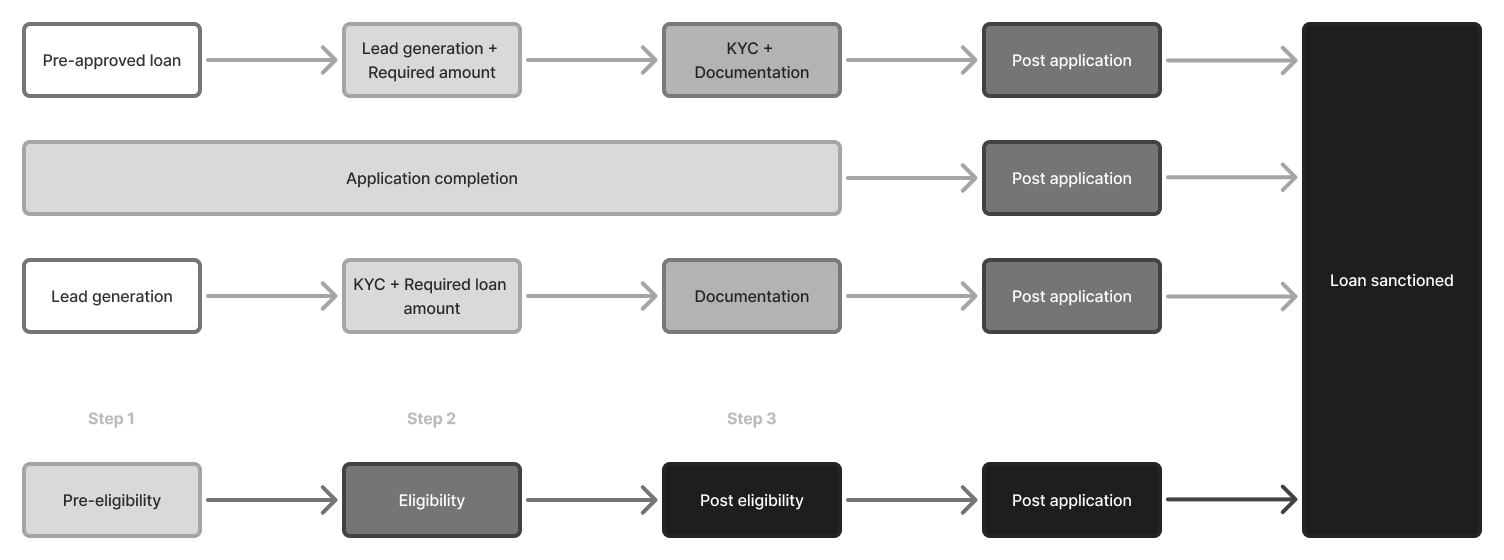
While studying existing client journeys and credit policies, three types of common journeys were prevalant. Out of it, came a 3-step application bound by customer eligibility that encapsulated all varieties of loan application journeys.
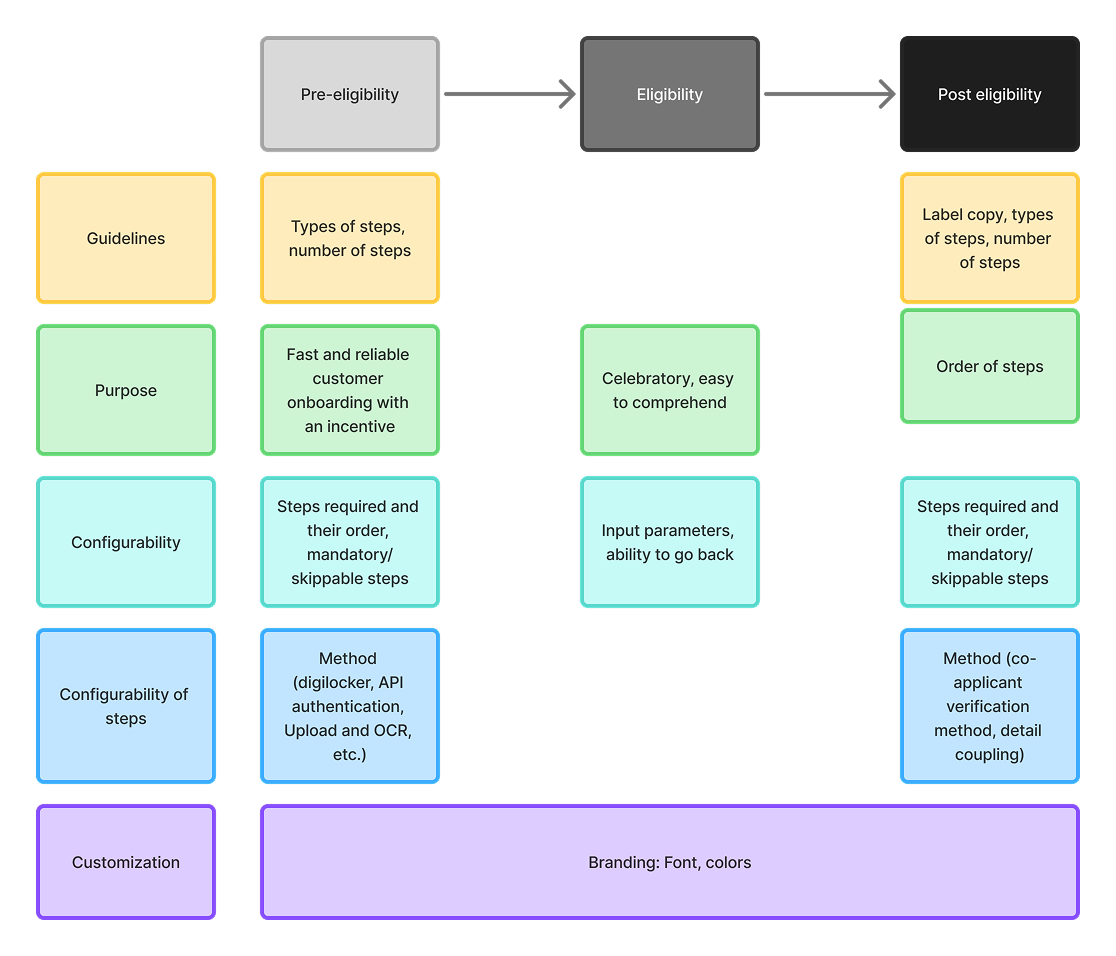
In the 3-steps, variabilities lived:
🎯
3-step application process comprising of pre-eligibility information, eligibility check, and post-eligibility documentation and details could cover any loan application journey.
User experience breakdown
User drop-off instances were rampant, financial institutions heavily relied on assisted journeys.
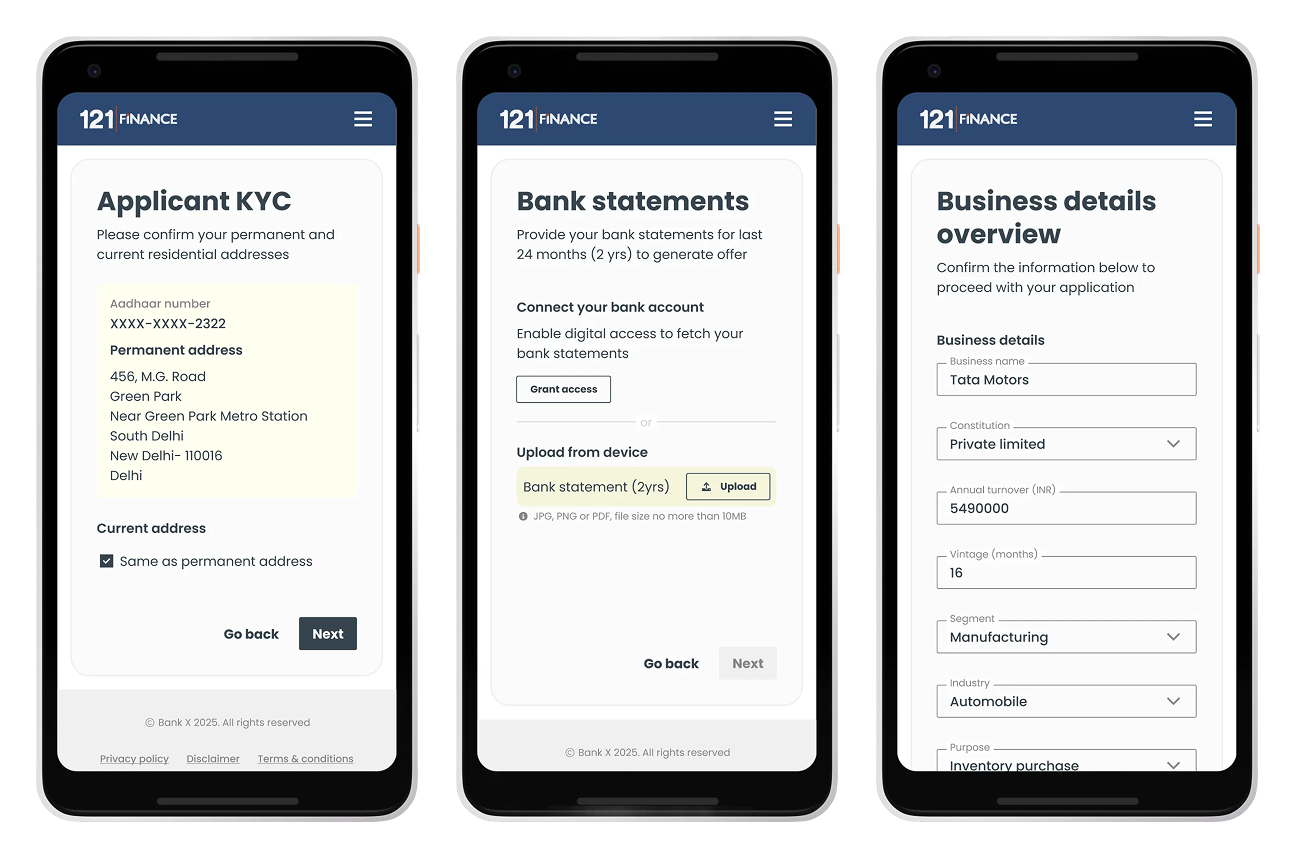
Loan applications across all financial institutions had the same way of navigation throughout the journey: Back and Next. Applicants had no visibility into:
The hypothesis was that these steps felt time-consuming and high-effort to the users. In addition, the entire application felt never-ending when coupled with additional documentations required. This lack of structure reduced trust and led to poor application completion—especially for complex loans.
🎯
Loan applications used simple Back/Next navigation, leaving users unaware of progress, upcoming steps, or total effort. Navigation felt chaotic, especially for complex multi-step actions making the process feel endless.
The solution
Navigation should match task complexity: Momentum vs control
➤ Pre-eligibility: Quick steps in linear progression to check eligibility
Key guiding principle: Pre-eligibility has to feel effortless to the user. Hence, the steps should retain the previous model for the user to keep going next with ocassional need of coming back.
An intuitive and encouraging progress stepper was the element that was going to make all the difference with:
Variants:
The UI works in tandem with guidelines and constraints to keep the intent of the design intact:
➤ Post Eligibility: Allow navigating back-and-forth for flexibility and control
Key guiding principle: Post-eligibility steps are complex
And hence, is typically a multi-session process, which may even span 2-3 days.
Hub-spoke navigation with status visibility for guidance:
➤ Configurability: Empowering financial institutions to build custom pre-eligibility and post eligibility steps
➤ Prototype: A sample lending journey showcasing all use-cases addressed with the design pattern:
🎯
Design navigation to match task complexity: momentum for pre-eligibility, control for post-eligibility. Pre-eligibility uses a lightweight, linear stepper (≤8 steps) to feel effortless and keep users moving, while post-eligibility shifts to a hub-and-spoke model that supports complex, failure-prone, multi-session tasks with clear status visibility.
Configuration
JSON driven UI as the first step to long-term SAAS vision
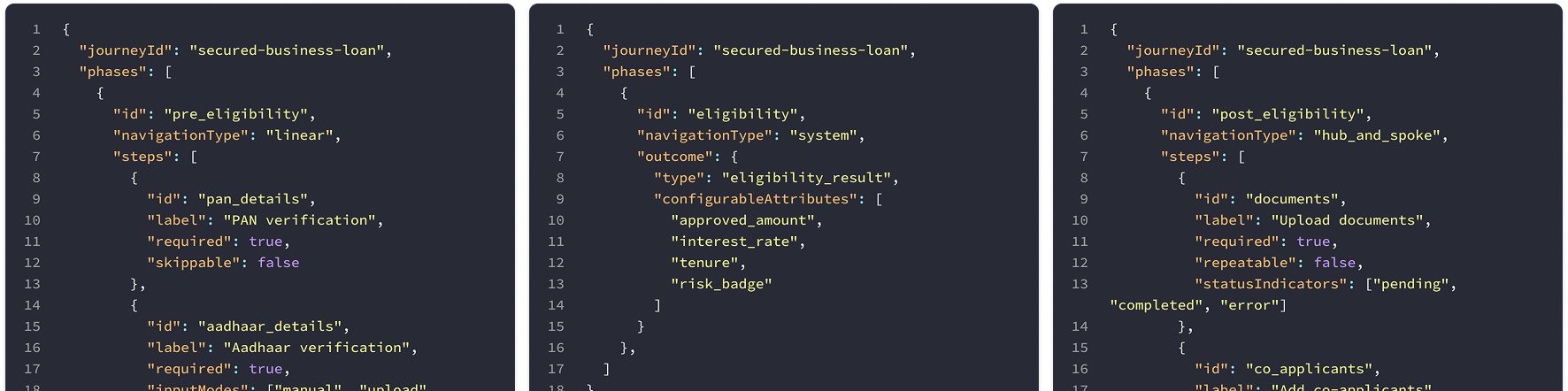
At the core of this system was a JSON configuration schema that acted as the single source of truth.
From a UX standpoint, the schema encoded:
By abstracting these decisions into configuration, new lender journeys could be launched without redesigning screens or interactions.
Configuration replaced customization.
🎯
A JSON-driven UI formed the foundation of the long-term SaaS vision, beginning with endless configurability on-demand.
Impact
When the system started working